Synopsis
Disc Centrifuge separation results depend on internal (centrifuge specific) and external (process fluid-related) factors. In this article, we discuss the common reasons behind disc stack centrifuge bad separation.
We will first discuss internal, i.e., centrifuge-related causes of bad separation results. Following this, we will discuss external factors that often affect separation results.
The machines described here are Alfa Laval disc stack centrifuges remanufactured by Dolphin: the MAB and MAPX purifiers, and the self-cleaning MOPX, WHPX, and WSPX bowls we rebuild every week. Dolphin Centrifuge is the independent specialist in Alfa Laval centrifuges, with remanufactured machines, turnkey systems, parts, and service built on 40+ years of Alfa Laval experience, and this guide is written by Sanjay Prabhu, M.S.M.E. Dolphin is an independent remanufacturer and is not affiliated with Alfa Laval. The principles below apply to most disc stack centrifuges from other manufacturers as well.
Disc Centrifuge Internal Factors Affecting Separation
The following is a list of mechanical factors related to the centrifuge construction and setting directly affecting separation results. We suggest possible ways to correct or adjust the centrifuge to get better results for each of the causes.
Incorrect Gravity Disc (Hole Too Small)
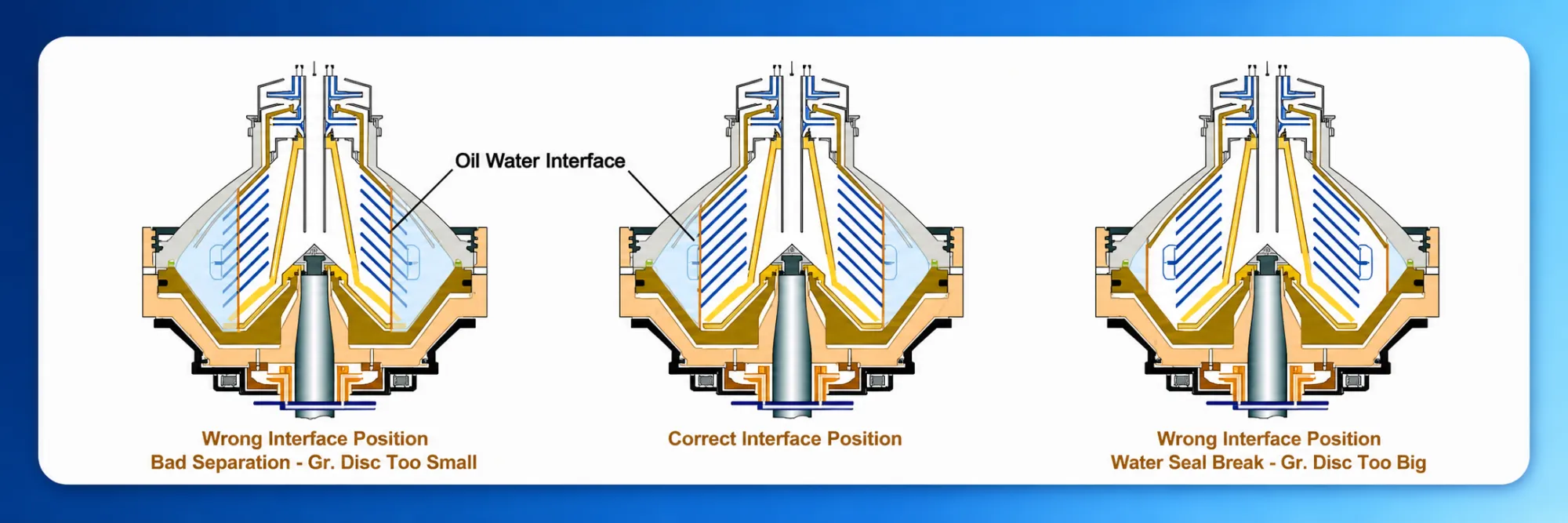
The gravity disc in the centrifuge bowl regulates the oil-water interface within the centrifuge. For best separation results, the oil-water interface should be closest to the bowl periphery without breaking the water seal. This interface positioning allows maximum g-force exerted by the rotation to act on the separation interface (shown below).
A gravity disc with a smaller hole size than the ideal one (as determined by the nomogram) pushes the oil-water interface radially inwards. This incorrect positioning of the interface causes bad separation. Most often, this is evident in the form of water being present in the clean oil phase.
The correct gravity disc (as indicated by the nomogram) will provide the best separation result. Therefore using the gravity disc with the largest hole size (without breaking over) is the right way to fix this unsatisfactory separation.
Each Alfa Laval bowl size has its own gravity disc set and its own nomogram. A MAB 206 or MAB 207 purifier, a MOPX 207, a MOPX 209, and a WHPX 405 all use different discs, so always work from the nomogram for the machine in front of you. Dolphin stocks gravity discs and Alfa Laval centrifuge parts for these models and will size the disc for your fluid if you send us the specific gravity and temperature.
Clogged Disc Stack
In cases where the sludge discharge frequency is inadequate, sludge can accumulate in the bowl to enter the inter-disc space. This sludge blocks the flow path of the separating fluids.
Blocked fluid pathways result in bad separation due to separated liquids' inability to exit the bowl per the design intent.
A thorough cleaning of the disc stack is the remedy to fixing this cause of bad separation.
Bowl Sludge Space Filled
The time between sludge discharge cycles is essential for self-cleaning centrifuges to operate efficiently. When the sludge discharge cycle time is too long, the separated sludge fills the sludge space and the water space. This excess sludge effectively shuts off the heavy-phase (water) pathway to the water discharge outlet (shown below).
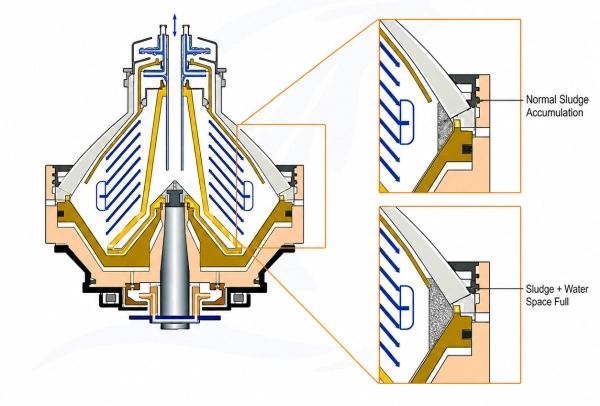
Since the separated water cannot exit the bowl through the intended discharge port, it leaves it with the separated oil. This water is now contaminating the clean oil, which leads to bad separation results.
Read our 101 Frequently Asked Questions about Disc Stack Centrifuges!
The solution to unsatisfactory sludge separation due to sludge buildup is to stop and clean the accumulated sludge. Also, a shorter sludge discharge cycle time helps prevent future sludge buildup.
Bowl Speed Low
Mechanical malfunction of the centrifuge can cause a reduction in the operating speed of the centrifuge. Lower operating speed leads to a reduced centrifugal force, which results in inadequate separation.
Identifying and correcting the mechanical cause of the reduced rotational speed typically fixes this problem.
The following are the common causes of reduced centrifuge speed.
- Centrifuge Brake Engaged
- Friction Pads are Worn-out or Oil-coated
- Bowl Leaking
- Motor Malfunction
- Bearing Failure
- Incorrect Parts for Operating Power Frequency
Other disc-centrifuge articles of interest
- Disc Centrifuge Backpressure - Comprehensive Guide
- 9 Steps to Selecting & Buying the Right Industrial Centrifuge
- Centrifuge RCF and RPM | Difference & RCF Calculation
- Disadvantages of a Disc-Stack Centrifuge | Illustrated Guide
- Difference Between Decanter & Disc Centrifuge | Technical Comparison
Disc Centrifuge External Factors Affecting Separation
External factors affecting centrifuge separation are related to the process fluid and operating environment of the centrifuge. The following two factors have a significant effect on separation efficiency and, thereby, separation results.
Low Process Fluid Temperature
The viscosity of the process fluid is a key parameter affecting the separation efficiency. As explained in our improving disc centrifuge efficiency, higher temperatures, especially for thick viscous fluids, reduce the fluid's viscosity.
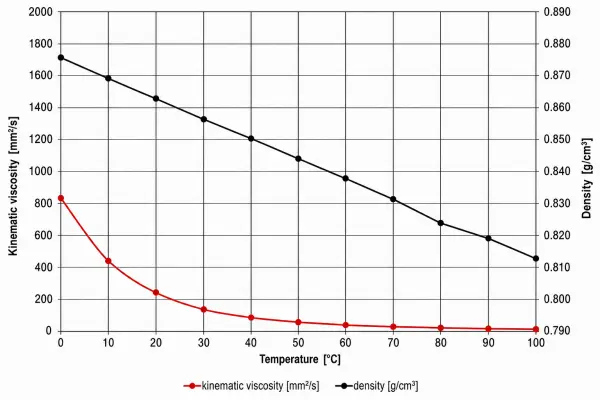
In most separation applications, higher processing temperatures lead to better separation results. Therefore, all other factors being similar, increasing the processing temperature results in better separation.
Excessive Flow-rate
Bowl residence time is another factor affecting separation in a disc centrifuge. Higher flow rates imply lower residence time. Therefore, for a given separation application, lower flow rates typically result in better separation results due to longer residence time in the bowl under the high g-force.
Summary
Bad separation results are a common problem for disc centrifuge operators. The six most common causes and respective fixes mentioned in this article should guide the centrifuge user to get optimum separation results, given the set process and centrifuge parameters.
by Sanjay Prabhu MSME
Engineering Manager, Dolphin Centrifuge