Indicative Pricing
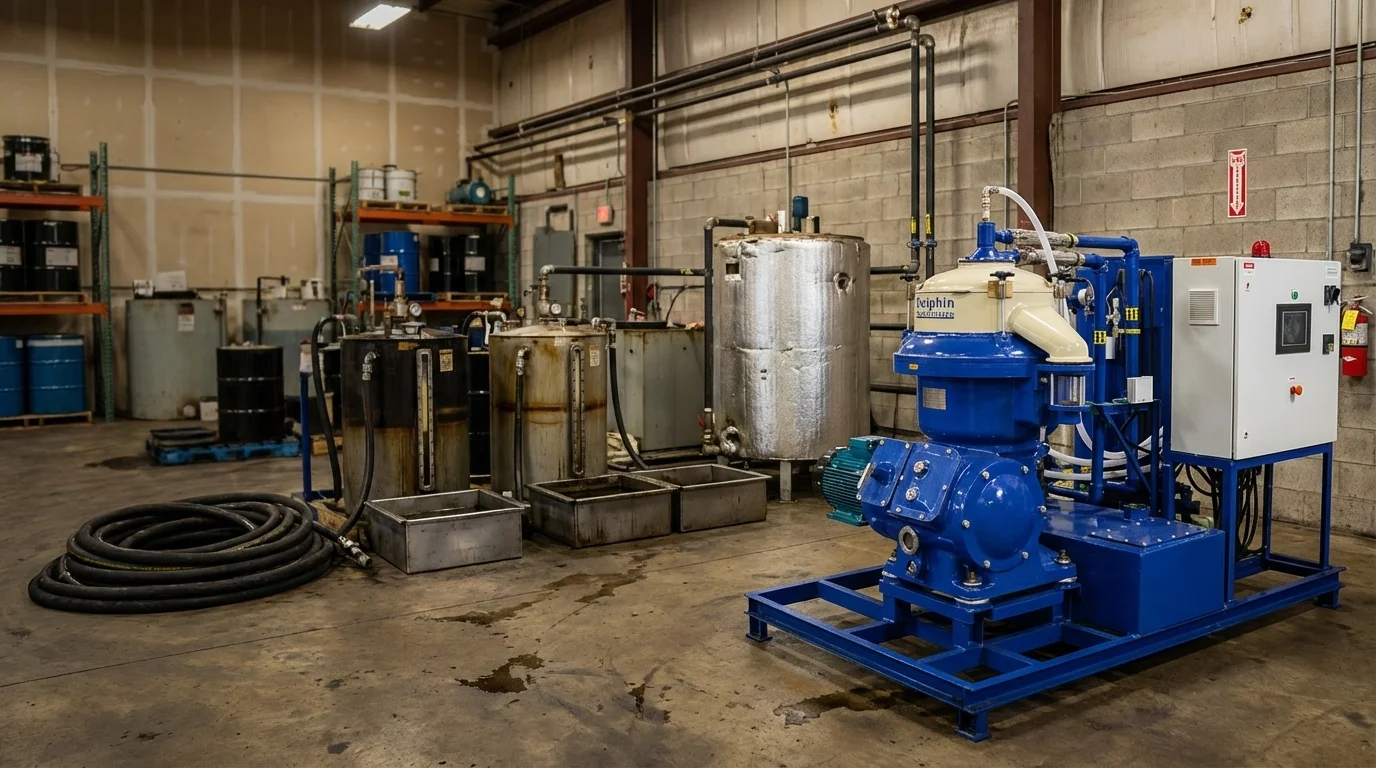
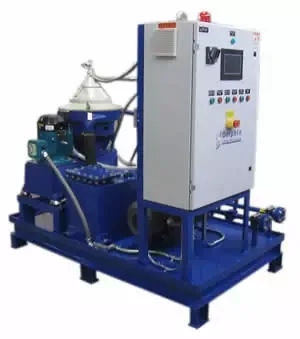
Complete plug-and-play modules start around $50K, EXW Warren MI. Systems are engineered and built in Michigan around remanufactured Alfa Laval separators, test-run before shipment, and backed by a 6-month mechanical warranty, US engineering support, on-site startup, and ongoing technical support.
Operation
A waste oil centrifuge works by exerting gravitational forces up to about 7,200 Gs depending on model to separate sediment and water from waste oil.
This force separates particles as small as 0.5 micron from the waste oil. The centrifuge has a flow-through design that enables the continuous flow of the separated contaminants through separate outlets.
Industrial waste oil centrifuges offer a large processing capacity. Continuous three-phase separation is the key to the efficient separation of waste oils.
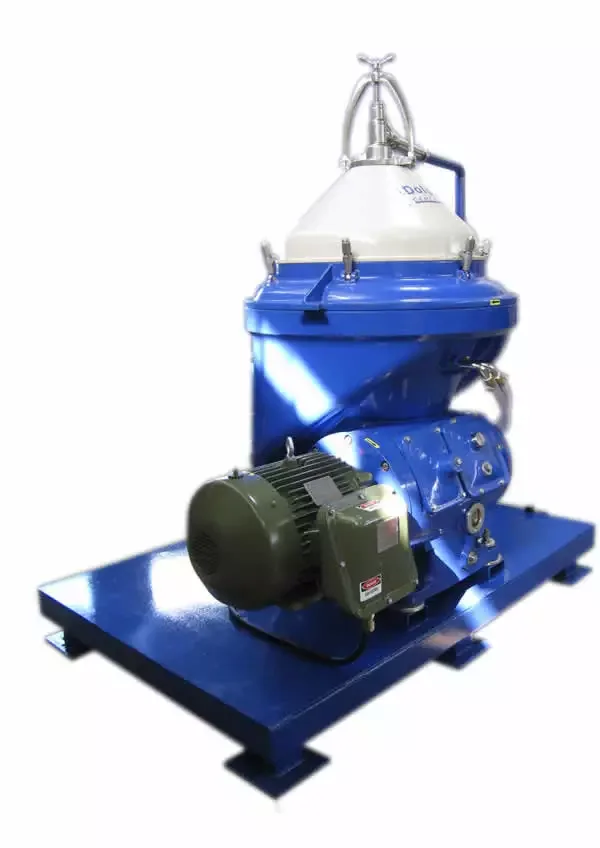
Every waste oil system on this page is built around a remanufactured Alfa Laval self-cleaning disc stack separator: the WHPX 405, WHPX 407, MOPX 209, and WHPX 513. Dolphin Centrifuge is the independent specialist in Alfa Laval centrifuges, with remanufactured machines, turnkey systems, parts, and service backed by 40+ years of Alfa Laval experience and engineered by Sanjay Prabhu, M.S.M.E. Apart from Alfa Laval itself, Dolphin is the reliable source for quality Alfa Laval waste oil separators in the United States. Dolphin is an independent remanufacturer and is not affiliated with Alfa Laval.
Three-phase separation means the separation of the three phases in contaminated oil:
- Light phase - oil (the clean, recovered product)
- Heavy phase - water (separated and discharged continuously)
- Sludge - solid contaminants (intermittently ejected from the bowl)
A waste oil centrifuge is a heavy-duty, industrial-grade machine. It has the added capacity to self-eject the separated solids and discharge separated water continuously.
See the real numbers from a U.S. military contractor's marine waste-oil installation ->
Pilot-scale Waste Oil Centrifuge Testing Video
Performance Results
How well does a disc centrifuge clean waste oil?
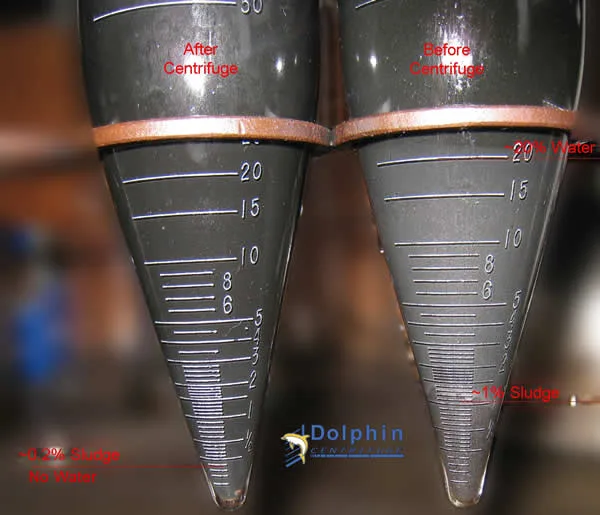
The following is a real-world example of our centrifuge performance results on waste oil. The table shows the contaminant levels in waste oil before and after an Alfa Laval MOPX-207 Centrifuge.
| Alfa Laval MOPX-207 Performance Data | ||
|---|---|---|
| Contaminant | Before | After |
| Sediment | 0.42% Wt. | 0.06% Wt. |
| Water | 38.0% Vol. | 1.2% Vol. |
| Trace Metals Removed: | ||
| Vanadium | 28 ppm | 31 ppm |
| Aluminum | 495 ppm | 85 ppm |
| Silicon | 386 ppm | 132 ppm |
| Ash Content | 1.17% Wt. | 0.09% Wt. |
Factors Affecting Centrifuge Performance
Temperature
Processing temperature is a key consideration while sizing waste oil centrifuges. Higher process temperature reduces the oil viscosity, which enables higher throughput.
Conversely, lower-temperature oil leads to lower capacity through the same centrifuge.
Flow Rate
Lower flow rates give higher retention time in the centrifuge bowl. This time enables longer exposure to the high centrifugal forces leading to better separation.
Inversely, higher flow rates lead to less effective separation.
Sizing
Industrial centrifuges used for waste oil purification are sized based on their throughput or processing capacity.
Centrifuges with processing capacities from 3 Gallons per Minute to over 100 Gallons per Minute are available for sale.
Due to the higher sludge levels in waste oil than in lube or hydraulic oil, self-cleaning centrifuges are required for waste oil processing.
For example, consider our medium capacity, self-cleaning Alfa Laval centrifuge, widely used for waste oil recovery. Notice the reduction in capacity at reduced oil temperature in the specifications below.
Packaged Systems
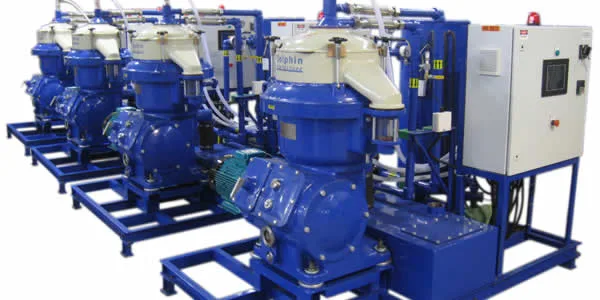
Dolphin Centrifuge offers complete, skid-mounted waste oil centrifuge systems in three capacity ranges, each built around a remanufactured Alfa Laval self-cleaning disc stack separator. All models use self-cleaning disc-stack technology with continuous flow-through operation. The skid, controls, heaters, and pumps are Dolphin engineering; the centrifuge inside is Alfa Laval.
| Specification | Alfa Laval WHPX-405 | Alfa Laval WHPX-407 | Alfa Laval WHPX-513 |
|---|---|---|---|
| Capacity | 15 GPM on 13 cSt diesel | 30 GPM | 72 GPM on 13 cSt diesel |
| Bowl Speed | 7,600 RPM | 7,000 RPM | 5,000 RPM |
| Drive Motor | 5 HP | 10 HP | 20 HP |
| Footprint | 4' × 5' | 6' × 5' | 7' × 6' |
| Weight | 2,500 lbs | 3,500 lbs | 5,000 lbs |
| Solids Handling | Up to 5% | Up to 5% | Up to 8% |
The WHPX-407 and WHPX-513 provide full 3-phase separation - simultaneously discharging clean oil, separated water, and sludge through dedicated outlets.
Utilities & Installation
All Alfa Laval WHPX systems require 480V 3-phase electrical power and compressed air for the self-cleaning mechanism. Potable water for the seal flush is optional. Units are skid-mounted and install in a standard industrial space - no special foundation is needed.
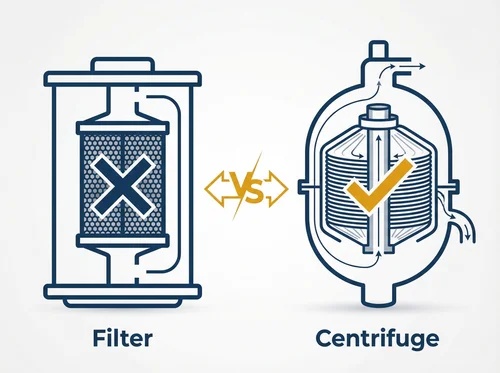
Advantages of Centrifuges Over Filters
- Total mechanical separation eliminates the need for filter media
- Continuous separation without downtime Associated with filter replacement
- High g-force allows separation down to 0.5 micron level
- Complete removal of all free water from waste oil
Waste Oil Centrifuge FAQ
Can a disc centrifuge separate emulsified waste oil?
Can a waste oil centrifuge remove fine metal contaminants from the oil?
Can your waste oil centrifuge separate antifreeze or glycol from the oil?
What happens to the separated sludge in a waste oil centrifuge?
Can we use a waste oil centrifuge for other applications such as diesel purification?
How does a disc stack centrifuge differ from other open bowl waste oil centrifuges?
Is a waste oil centrifuge a flow-through type separator?
What is the smallest capacity Alfa Laval waste oil centrifuge?
Can a waste oil centrifuge remove the black color from waste oil?
Need Help Sizing a Waste Oil Centrifuge?
Tell us your daily volume, oil type, and processing temperature. Our engineers will recommend the right centrifuge system for your waste oil application. You can also read our guide on how to pick the right industrial centrifuge.
Specifications
The following table highlights the specifications of our most popular large-scale waste oil processing disc-stack centrifuges.
| Feature | MOPX-207 | MOPX-210 |
|---|---|---|
| Separation Quality | 0.5µ; Total Water Removal | 0.5µ; Total Water Removal |
| Rated Capacity | 32 GPM | 72 GPM |
| Actual Capacity at Temp: | ||
| @ 70°F (Ambient) | 5–7 GPM | 12–15 GPM |
| @ 140°F | 10–12 GPM | 20–24 GPM |
| @ 200°F | 20+ GPM | 45+ GPM |
| Drive Motor | 7.5 HP | 15 HP |
| Centrifugal Force | 7,200 Gs | 6,800 Gs |
| Operating Voltage | 230 / 460 V - 3 Phase | 230 / 460 V - 3 Phase |
| Bowl Speed | 7,200 RPM | 5,100 RPM |
| Material of Construction (MOC) | 316L Stainless Steel (Bowl Parts); Nickel Plated non-SS Bowl Parts | |
| Skid Size | 4' x 5' x 6' (H) | 6' x 7' x 8' (H) |
| System Weight | 2,800 Lbs | 4,000 Lbs |
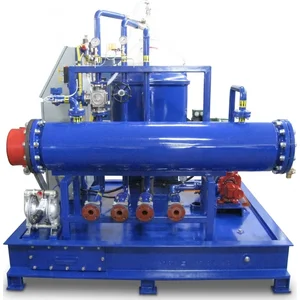
Installation Requirements
- Electrical
- 460 V / 3-phase standard; 240 V / 3-phase available. Single-phase sites: customer can add a phase converter.
- Operating water
- 50 psig, clean potable filtered water - city water works best, soft water only.
- Compressed air
- 100 psig, ~15 cfm (portable compressor is fine). Primary use: AODD sludge pumps on self-cleaning machines.
- Feed
- Hotter separates better - WVO/thick/emulsified oils ideal ~180°F; HFO 200°F+. Pre-strain dirty feed to under 250 microns. A PLC-controlled feed pump is usually built into the skid; if customer-supplied, use positive-displacement/AODD pumps - avoid centrifugal pumps on emulsion-prone fluids.
- Drain
- Separated sludge via AODD pump, 1 to 1.5 inch outlet. Separated water: 1 to 1.5 inch pressurized, or 3 to 4 inch gravity drain.
- Foundation & environment
- Level concrete pad is usually sufficient; small units available on portable cart skids. Indoor install preferred. Outdoor installs must be in a climate-controlled/heated enclosure to prevent freezing - freezing is a safety hazard.
Black Diesel
Black diesel is a term used to describe used engine and other used mineral oils that are repurposed as fuel for diesel engines and diesel generators.
Separating sub-micron carbon and ash requires high G-force to achieve a combustible quality.
For stored diesel cleanup, see our diesel fuel centrifuge systems.
Installation
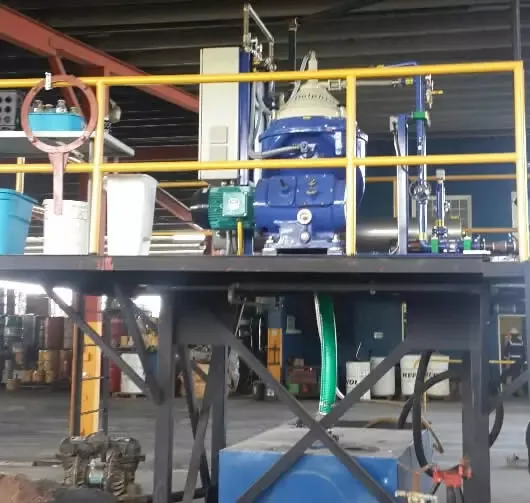
A typical waste oil centrifuge installation requires certain auxiliary equipment and site features for the optimum and durable operation of the centrifuge system.
Recommended Ancillary Equipment:
- Elevated Platform: Most self-cleaning centrifuges discharge the sludge through the bottom of the centrifuge frame. Therefore an elevated platform allows a sludge receptacle to be located under the centrifuge.
- Overhead Lifting Device: Disc stack centrifuge bowls are heavy parts that need mechanical assistance for retraction from the centrifuge frame. An overhead lift or hoist facilitates the easy retraction and reinstallation of the bowl for service.
- Extended Access Platform (Catwalk): An extended platform around the centrifuge skid allows the operator easy access to the centrifuge for operation and service purposes. A guardrail is essential for the safety of the operators at the elevated location.
- Sludge Receptacle and Transfer Pump: A sludge tank (receptacle) with an attached sludge pump is the ideal way to handle the separated sludge discharged from the centrifuge.
- Operating Water Supply Line: A non-corrosive water supply pipe with a minimum recommended flow rate of water is essential for the trouble-free operation of the waste oil centrifuge.
Industrial Scale Processing
Small-scale centrifuges (open, top-loading type) produce approximately 2,500 g force. This force is enough to separate bulk sludge from the waste oil but not separate the small particles.
Our industrial waste oil centrifuges generate up to 8,000 g's. Separating microscopic solid particles from the contaminated oil requires a higher g-force. Industrial centrifuges best handle the commercial processing of waste oil. Alfa Laval disc stack centrifuges have a continuous flow-through design and are perfect for this application.
Industrial-scale waste oil centrifuges are NOT cost-competitive for DIY or small-scale WVO separation. These waste oil centrifuges are workable for large-scale or commercial processors.
Our turn-key waste oil purification systems range from 500 Gal/Day to over 10,000 Gal/Day.
Decanters for High Sludge
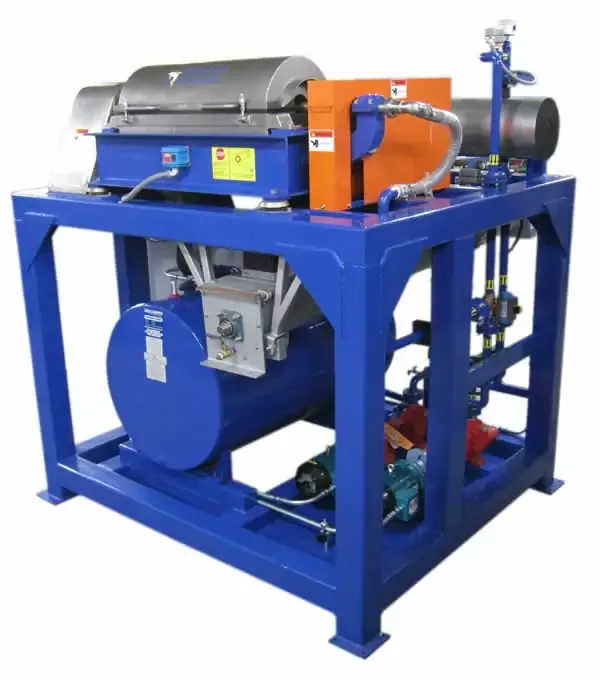
Waste oil decanters are well suited for de-sludging of high-sludge waste oil. Refinery waste slop and tank bottom sludge are typical examples. This process is also known as sludge thickening. A decanter centrifuge continuously handles high levels of sludge (up to 40%).
Alfa Laval decanters replace belt presses and screw presses in many demanding high-sludge applications.
Waste Oil Filter versus Centrifuge
This section will delve into commercial aspects of waste oil recycling using filters versus centrifuges.
Using Filters for Waste Oil Recycling
Filtration is not suitable for large-scale processing of used engine oil due to the ongoing cost of labor and material involved.
Consider a large-scale used oil collector who wants to process 10,000 gallons daily. Their collection consists of WVO, UCO, Waste Oil, Yellow Grease, and any other used oil. The first step involves heating and settling to remove the free water.
This process requires significant tank volume with heat for the 'heating and settling' routine. Despite the time and heating cost, this method still does not remove all free water.
Let's not forget about the sludge left in the settling tanks! That sludge contains significant amounts of oil, which means lost revenue. Also, the tank bottoms need cleaning.
Next, filtering the decanted waste oil through bag filters is labor-intensive. Replacing and disposing of filter media adds to cost and time. Cleaner oil requires small mesh filters, which means frequent media replacement and more material and labor costs.
The 'finished product' contains water. Water removal requires adsorption or 'boiling off,' which adds extra cost to the process. Water removal by settling adds time to the process.
The capital expense of centrifuge equipment is more compared to decanting and filtration. The payback period of a centrifuge system is short, considering all costs. It is often in months, depending on the volume of oil processed.
Waste Oil Separation Using Industrial Centrifuge
Industrial Process Flow
The Continuous Cycle:
- 1
Primary De-sludging: Handled by a decanter centrifuge to remove bulk solids (1/2" down to 50 microns).
- 2
High-Efficiency Heating: Inline electric heaters raise temp to 200°F only for active process fluid.
- 3
Disc Centrifuge Finishing: Up to about 7,200 Gs depending on model remove all free water and particles down to 0.5-micron level.
A decanter centrifuge is a heavy-duty continuous de-sludging machine. It generates approximately 3,100 times the force of gravity by centrifugal force. The decanter centrifuge processes incoming crude oil to remove all solids from 1/2" down to a 50-micron level in a single pass.
The de-sludged oil and water are then pre-heated. A high-efficiency inline electric heater heats the fluid. An inline electric heater is energy efficient because it heats only the in-process liquid. Heating the entire tank volume is wasteful.
The heated waste oil is now processed through a self-cleaning, high-speed disc centrifuge. These industrial centrifuges generate up to about 7,200 times the force of gravity, depending on model. This g-force is enough to separate all free water and solid particles down to the 0.5-micron level.
This centrifuge machine continuously separates the water and intermittently ejects the separated solids. A PLC in the local centrifuge control panel controls the entire process. It also controls the sludge ejection system.
The process illustrated and described above is ideal for commercial-scale waste oil purification. This separation is a continuous process without media and labor costs.
Processing Pyrolysis Oil? Read about Industrial Centrifuges for Pyrolysis Oil production.
Waste Oil Centrifuges for Sale - Used & Remanufactured Alfa Laval Models
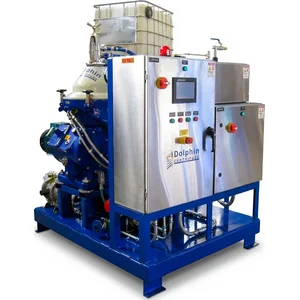
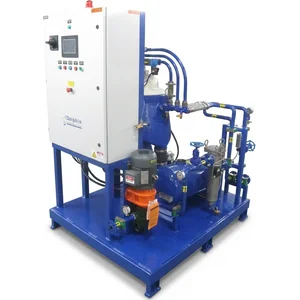
The following models show 3 Alfa Laval centrifuges of different capacities for processing Used Engine Oil. These Alfa Laval models are widely used as a used motor oil centrifuge or waste motor oil centrifuge for high-volume oil recovery. Hover on each model for technical specifications.
Each machine is a used Alfa Laval separator remanufactured, test-run, and warrantied at Dolphin's Warren, Michigan shop. Dolphin Centrifuge is an independent remanufacturer and is not affiliated with Alfa Laval.
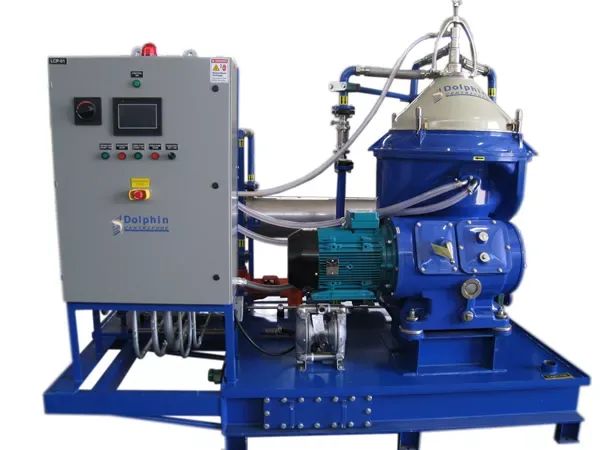
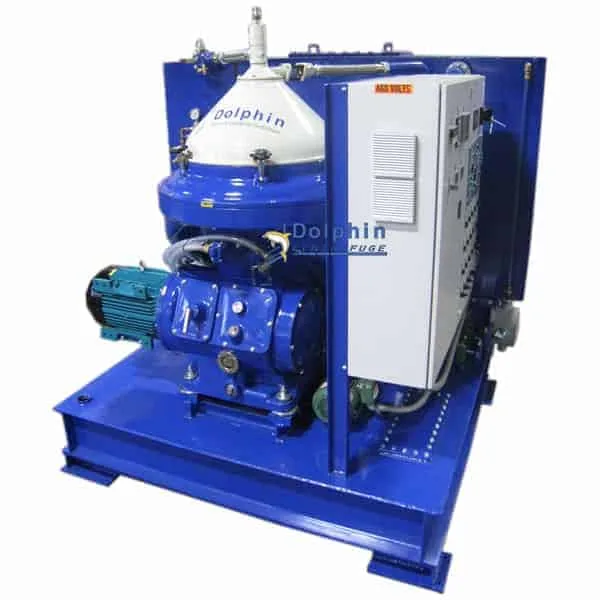
Alfa Laval WHPX-405
| Type: | 3-Phase; Self-Cleaning |
| Bowl RPM: | 7,600 RPM |
| G-Force: | 7,200 Gs |
| Capacity: | 15 GPM on 13 cSt diesel |
| Motor: | 4 HP |
| Power: | 460V; 20A |
| Size: | 4'×5'×5'H |
| Weight: | 1,800 Lbs |
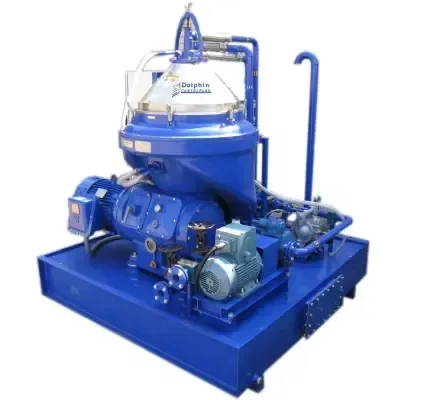
Alfa Laval MOPX-209
| Type: | 3-Phase; Self-Cleaning |
| Bowl RPM: | 6,500 RPM |
| Capacity: | 40 GPM @ 180°F |
| Motor: | 10 HP |
| Power: | 460V; 50A |
| Size: | 5'×6'×7'H |
| Weight: | 3,500 Lbs |
Alfa Laval WHPX-513
| Type: | 3-Phase; Self-Cleaning |
| Bowl RPM: | 6,300 RPM |
| Capacity: | 72 GPM on 13 cSt diesel |
| Motor: | 15 HP |
| Power: | 460V; 60A |
| Size: | 6'×7'×7'H |
| Weight: | 4,500 Lbs |
Technical Reading
Waste Oil Recovery Case Study
Real-world results for ash and metal removal from used engine oils.
Used Oil Centrifuge Guide
Comprehensive overview of industrial centrifuge roles in oil recycling.
Pyrolysis Oil production
Separation and purification techniques for pyrolysis-derived fuels.
Mechanical Emulsion Breaking
Using up to about 7,200 Gs depending on model to break chemical-free waste oil emulsions.
Black Diesel Centrifuges
Converting used engine oil into combustible diesel fuel.
Sample Testing Program
Validate centrifuge performance on your specific oil before purchasing.