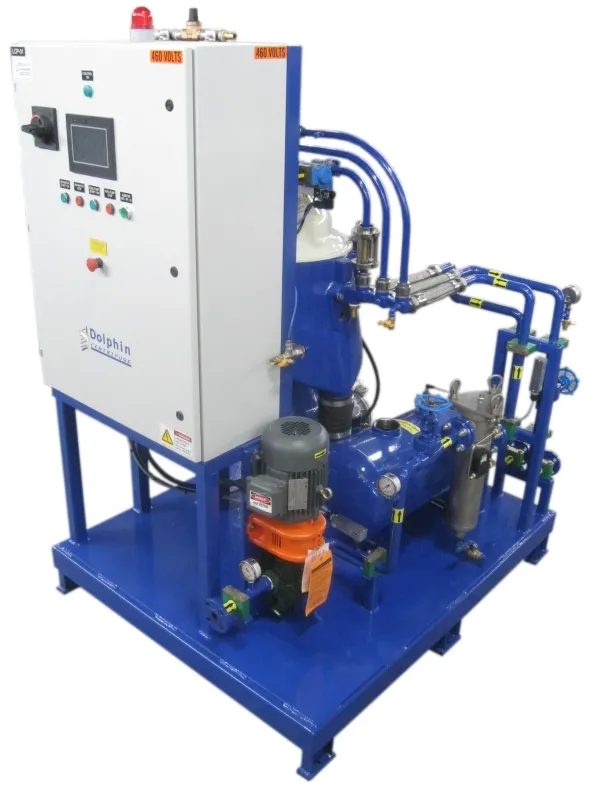
The DMPX-014 is a Dolphin-engineered turnkey module class supplied with a remanufactured Alfa Laval MOPX 205 or WHPX 405. Published diesel capacity is 3,300 L/h (14.53 US GPM derived) for MOPX 205 and 3,700 L/h (16.29 US GPM derived) for WHPX 405, both at 40°C and 13 cSt. The separate WHPX 405 rated-reference value is 5,500 L/h (24.22 US GPM derived), but its source fluid is unspecified and it is not a universal DMPX-014 rating.
DMPX-014 Self-Cleaning Three-Phase Disc Stack Centrifuge
The DMPX-014 is Dolphin Centrifuge’s popular mid-range self-cleaning disc stack module. It separates two immiscible liquids plus solids and is supplied with either a MOPX 205 or WHPX 405 base machine. The published diesel values differ by base machine, and lube oil, waste oil and biodiesel duties remain tied to their exact fluid conditions and application sizing.
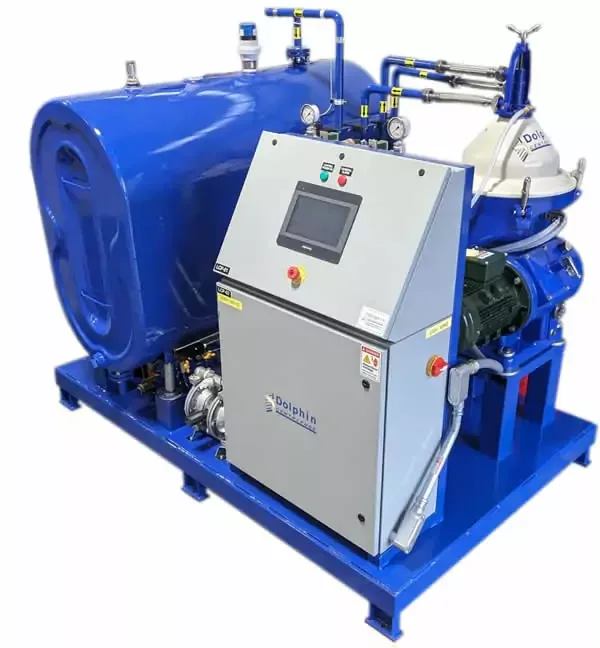
How Three-Phase Separation Works
Conventional two-phase centrifuges separate a single liquid phase from suspended solids. The DMPX-014 is a true three-phase separator: it simultaneously processes a feed stream containing two immiscible liquids (for example, oil and water) plus suspended solid particles, producing three separate output streams in a single continuous pass.
Inside the spinning bowl, centrifugal force stratifies the feed by density. The light liquid phase (oil, lower density) migrates inward and exits through the light-phase outlet. The heavy liquid phase (water or aqueous solution, higher density) migrates toward the bowl wall and exits through the heavy-phase outlet. Solid particles, being densest of all, accumulate at the bowl periphery and are ejected through hydraulically actuated discharge ports during programmed cleaning shots.
This three-phase capability eliminates the need for separate oil-water separators and filter systems downstream of the centrifuge. One machine does what previously required multiple process steps.
Test Your Fluid on the DMPX-014
Send us a sample and we will test it on the DMPX-014 at our Warren, Michigan facility. Sample testing is a chargeable service. See real separation results before you commit.
DMPX-014 Specifications
| Parameter | Value |
|---|---|
| Base machine | Alfa Laval MOPX 205 or WHPX 405 (remanufactured) |
| Separation type | Three-phase (light liquid / heavy liquid / solids) |
| WHPX 405 bowl speed | 7,600 RPM; confirm separately for a MOPX 205 build |
| MOPX 205 diesel capacity | 3,300 L/h (14.53 US GPM derived), 40°C, 13 cSt |
| WHPX 405 marine-diesel capacity | 3,700 L/h (16.29 US GPM derived), 40°C, 13 cSt |
| WHPX 405 rated reference | 5,500 L/h (24.22 US GPM derived); source fluid unspecified, not an application capacity |
| Bowl sludge capacity | 0.32–0.34 gallons |
| Drive motor | 5 HP (3.7 kW) standard; explosion proof available |
| Bowl construction | Carbon steel standard; 316L stainless steel available |
| Solids ejection | Hydraulic self-cleaning; PLC-controlled intervals |
| Skid dimensions (approx.) | 36" W × 60" L × 60" H (skid-mounted system) |
| Power supply | 230V or 460V / 3-phase / 60 Hz (other voltages available) |
| Control system | PLC with HMI; programmable discharge intervals and alarms |
Capacity by Fluid and Exact Base Machine
| Exact base machine | Fluid and source conditions | Published capacity | Derived capacity |
|---|---|---|---|
| MOPX 205 | Gas oil at 40°C | 4,900 L/h | 21.57 US GPM |
| MOPX 205 | Diesel, 13 cSt at 40°C | 3,300 L/h | 14.53 US GPM |
| MOPX 205 | R&O / engine lube oil, centrifuged at 80–90°C | 1,700 L/h | 7.48 US GPM |
| MOPX 205 | Steam turbine lube oil, centrifuged at 60–70°C | 3,200 L/h | 14.09 US GPM |
| WHPX 405 | Rated reference; source fluid unspecified | 5,500 L/h | 24.22 US GPM |
| WHPX 405 | Marine diesel, 13 cSt at 40°C | 3,700 L/h | 16.29 US GPM |
| WHPX 405 | HFO 30 cSt at 50°C; centrifuged at 70–98°C | 3,400 L/h | 14.97 US GPM |
| WHPX 405 | HFO 40 cSt at 50°C; centrifuged at 80–98°C | 3,400 L/h | 14.97 US GPM |
| WHPX 405 | HFO 60 cSt at 50°C; centrifuged at 80–98°C | 2,600 L/h | 11.45 US GPM |
| WHPX 405 | HFO 100 cSt at 50°C; centrifuged at 90–98°C | 2,500 L/h | 11.01 US GPM |
| WHPX 405 | HFO 180 cSt at 50°C; centrifuged at 90–98°C | 1,700 L/h | 7.48 US GPM |
| WHPX 405 | HFO 380 cSt at 50°C; centrifuged at 98°C | 1,400 L/h | 6.16 US GPM |
| WHPX 405 | Cross-head R&O lube oil, centrifuged at 80–90°C | 1,700–1,900 L/h | 7.48–8.37 US GPM |
| WHPX 405 | Steam turbine lube oil, centrifuged at 60–70°C | 3,600 L/h | 15.85 US GPM |
Source L/h values are canonical. US GPM is derived as L/h ÷ 227.124707 and rounded to two decimals. HFO values apply only to WHPX 405; none is transferred to MOPX 205. See the technical-data methodology and machine-readable DMPX-014 record. Dolphin is an independent remanufacturer and is not affiliated with Alfa Laval.
Key Applications
Waste Oil Reclamation
Used motor oil, transmission fluid, hydraulic oil, and industrial waste oils contain water, soot, and metal wear particles. The DMPX-014 separates all three phases continuously, producing dry solids discharge, clean water discharge, and reclaimed oil ready for re-use or re-refining. Operates at elevated temperature (180–200°F) for optimal viscosity reduction.
Waste Oil Centrifuge Details →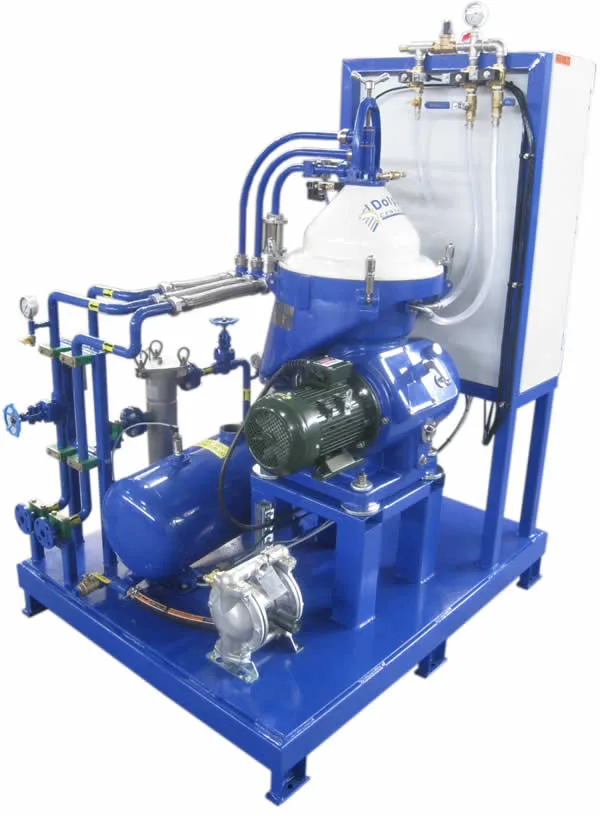
Biodiesel Production — Glycerin Separation
Transesterification of vegetable or animal fats produces biodiesel (FAME) plus a glycerin-rich heavy phase containing methanol, soap, and catalyst residues. The three-phase DMPX-014 separates biodiesel, glycerin, and any solid impurities in a single step, replacing multiple wash tanks and settling vessels in the production sequence.
Biodiesel Centrifuge Details →Fish Oil Processing
Fish oil separation requires simultaneous recovery of oil, clarification of stickwater, and removal of fine solid particulates. The DMPX-014 with stainless steel construction handles fish oil, producing a clean oil phase and separated aqueous phase in continuous operation.
Emulsified Waste Oil with High Water Cut
Tank bottoms, oilfield slop, and industrial oily water with 20–60% water content require three-phase centrifugation to break the emulsion and recover usable oil. The DMPX-014 handles feeds with significant water cut that two-phase centrifuges cannot process efficiently.
Self-Cleaning Solids Ejection
The DMPX-014’s self-cleaning mechanism uses hydraulic pressure to actuate piston ports at the bowl periphery. During a discharge (cleaning shot), the bowl periphery opens momentarily, ejecting accumulated solids as a wet sludge into the solids collection shroud. The entire discharge cycle takes less than one second and the machine immediately resumes full-speed separation.
Discharge frequency is programmed through the PLC based on the solids loading of the feed. Applications with heavy solids (waste oil, tank bottoms) typically use discharge intervals of 15–60 minutes. Low-solids applications (diesel polishing, biodiesel washing) may discharge every few hours. The PLC can also trigger partial discharges to avoid unnecessary dilution of the separated product.
Because solids ejection is automatic, the DMPX-014 runs unattended in continuous 24/7 operation without manual cleaning shutdowns — a key advantage over manual-clean centrifuge designs.
Skid-Mounted System Option
Dolphin Centrifuge supplies the DMPX-014 as a complete, tested, skid-mounted system. The standard DMPX-014 skid includes:
- • DMPX-014 centrifuge with drive motor and frame
- • Feed pump (positive displacement or centrifugal) with variable speed control
- • Electric or steam heat exchanger / pre-heater (for viscous fluids)
- • Stainless steel or carbon steel structural skid frame
- • Pre-wired PLC control panel with HMI touchscreen
- • All process piping and instrumentation
- • Solids collection pan and clean-out port
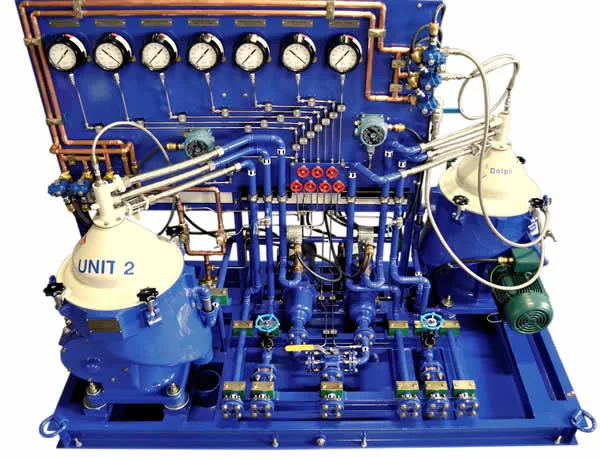
The skid arrives ready to connect to feed supply, product outlets, utilities (power and water for hydraulic operation), and drains. Commissioning typically requires less than one day. Explosion proof skid configurations are available for Class I Division 1 and Division 2 hazardous locations.
Why the DMPX-014 Is Our Most Popular Mid-Range Model
The DMPX-014 occupies the space between compact entry-level machines and larger industrial units. Published diesel capacity is 3,300 L/h (14.53 US GPM derived) on MOPX 205 and 3,700 L/h (16.29 US GPM derived) on WHPX 405. Waste oil and biodiesel flows are application-specific and are not inferred from these diesel values.
Its self-cleaning design makes it suitable for feeds with significant solids loading that would require frequent manual shutdowns on a simpler bowl centrifuge. Operators with experience on manual-clean machines who switch to the DMPX-014 consistently report that labor time drops dramatically while processing quality improves.
For a detailed comparison of DMPX-014 against other Dolphin centrifuge models, see our centrifuge selection guide.
Frequently Asked Questions
What is the diesel capacity of the DMPX-014?
DMPX-014 is not one universal flow rating. The MOPX 205 published diesel capacity is 3,300 L/h (14.53 US GPM derived), while the WHPX 405 marine-diesel value is 3,700 L/h (16.29 US GPM derived). Both records are at 40°C and 13 cSt.
Is 5,500 L/h the diesel capacity of every DMPX-014?
No. The 5,500 L/h (24.22 US GPM derived) value is a WHPX 405 rated reference whose source fluid is unspecified. It is not a diesel, water, waste-oil, or universal DMPX-014 application capacity.
What is the WHPX 405 capacity for HFO 180 cSt?
The published WHPX 405 HFO 180 cSt capacity is 1,700 L/h (7.48 US GPM derived), with viscosity specified at 50°C and centrifugation at 90–98°C. The HFO curve belongs only to WHPX 405 and is not assigned to MOPX 205.